Roberto Matta: Inner Space, Surrealism and Fields of Energy
Roberto Matta transformed architectural space and Surrealist automatism into unstable psychological landscapes that influenced postwar painting across continents.
- Roberto Matta
- Chilean art
- Surrealism
- psychological morphologies
- Abstract Expressionism
- Latin American modernism
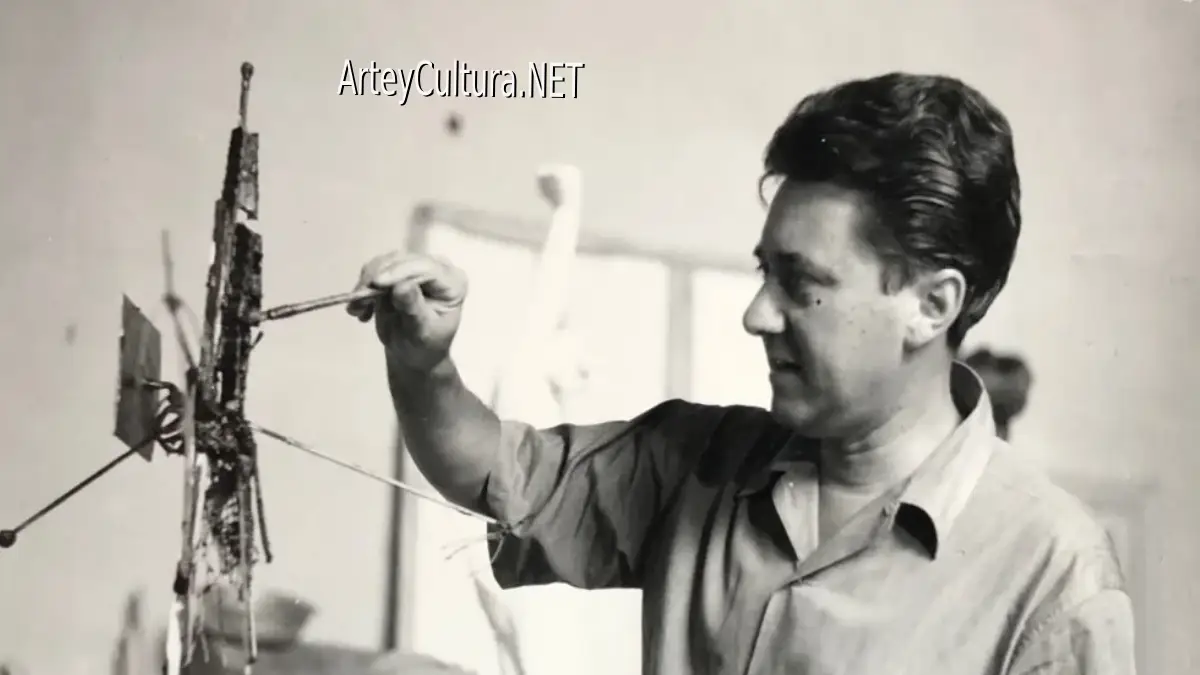
Roberto Sebastian Antonio Matta Echaurren was born in Santiago, Chile, on November 11, 1911, and died in Civitavecchia, Italy, on November 23, 2002. His paintings turned space into a volatile field where mind, technology, history and the body continually transform one another.
From architecture to painting
Matta studied architecture at the Pontifical Catholic University of Chile and travelled to Europe, where he worked briefly in Le Corbusier’s studio. Architectural training remained visible after he abandoned conventional building practice.
His canvases often feel like interiors without walls, maps of energy or environments unfolding beyond the frame. Perspective became a psychological and temporal problem rather than a neutral system.
Surrealism and psychological morphologies
Through contacts including Federico Garcia Lorca, Salvador Dali and Andre Breton, Matta entered the Surrealist circle. Automatism allowed a work to begin without a fully predetermined design.
He used the term psychological morphology for images seeking to register fear, desire and thought before they settle into familiar figures. Fluid forms, multiple horizons and unstable depths place consciousness in motion.
A door to another dimension
This Spanish-language documentary surveys Matta’s life and changing work. Its extended visual sequences show how ideas from architecture, science and philosophy entered painted spaces that appear larger than their physical support.
New York and transatlantic influence
During the Second World War, Matta joined other exiled Surrealists in New York. His large surfaces and automatic spatial structures affected younger American artists in the environment from which Abstract Expressionism emerged.
Influence travelled both ways. Matta absorbed the scale and gestural energy of New York painting, becoming a bridge rather than a simple transmitter between European and American movements.
Matta’s restless language
This Spanish first-person recording captures Matta’s associative speech and delight in remaking words. He speaks as he paints: connections multiply, meanings remain mobile and fixed answers are treated with suspicion.
Politics, machines and collective history
After the war, hybrid beings and mechanical conflicts populated his pictures. He responded to political violence, supported Latin American causes and participated in collective projects.
Technology appears as both possibility and threat. Figures act inside systems they cannot fully control, turning inner space into a model of social and historical pressure.
The legacy of Roberto Matta
Matta was a central figure of late Surrealism and one of Chile’s most internationally influential artists. He made the canvas a field of forces rather than a stable window. His legacy persists wherever art asks what it feels like to inhabit a reality continuously reorganised by desire, machines and power.