Paul Klee: Line, Colour and the Practice of Visual Thought
Paul Klee united music, natural processes, humour and formal analysis in paintings and drawings that continue to shape modern art and creative education.
- Paul Klee
- Bauhaus
- modern art
- Swiss artists
- colour theory
- abstract art
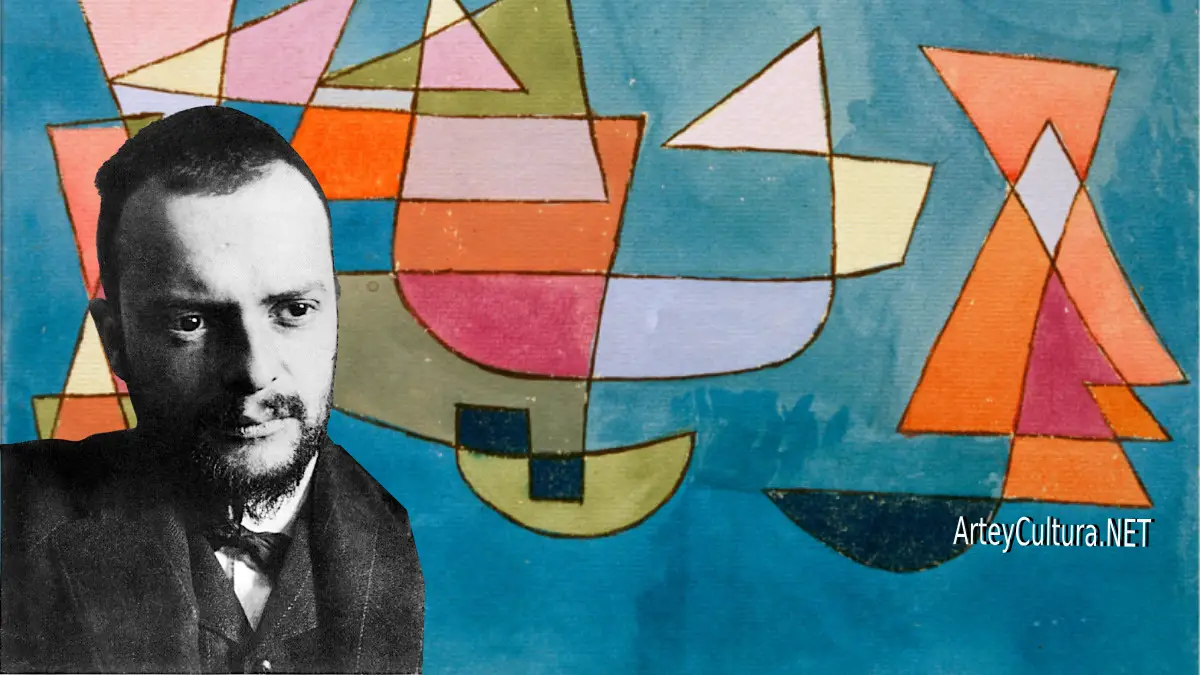
Paul Klee was born in Munchenbuchsee, Switzerland, on December 18, 1879, and died in Muralto on June 29, 1940. Painter, draughtsman, musician and teacher, he approached art as a living process in which line, colour and growth obey related but never rigid laws.
Music and artistic formation
Klee grew up in a musical family and became an accomplished violinist. He chose visual art professionally, studying in Munich and developing slowly through drawing, satire and experiments with printmaking.
Music remained a structural resource. Rhythm, variation, polyphony and notation offered ways to think about visual relationships, though his paintings are not simple translations of particular compositions.
Tunisia and the discovery of colour
A journey to Tunisia in 1914, undertaken with August Macke and Louis Moilliet, became a celebrated turning point. Architecture and intense light encouraged Klee to organize colour more independently from descriptive drawing.
The transformation was gradual rather than miraculous. It built on earlier research and continued through watercolour grids, transparent layers and subtle tonal sequences.
Making the invisible visible
This English-language film explores Klee’s ambition to reveal processes that cannot be copied directly from appearances. Growth, motion and memory become visible through signs, directional lines and transformations of shape.
Teaching at the Bauhaus
Klee taught at the Bauhaus from 1921 to 1931. His courses investigated point, line, plane, colour, balance and movement through carefully sequenced exercises. The surviving pedagogical notebooks show analysis supporting imagination rather than suppressing it.
He encouraged students to study how nature forms structures instead of merely imitating finished surfaces. A leaf, river or organism could suggest principles of branching, circulation and change.
Life and art explained
This English documentary follows Klee’s stylistic development and historical circumstances. Its broad selection demonstrates why no single label—abstraction, Surrealism, Expressionism or fantasy—fully contains his work.
Persecution and late work
After the Nazis took power, Klee lost his teaching position in Dusseldorf and returned to Switzerland. His art was removed from German museums and displayed as so-called degenerate art.
Illness increasingly restricted his body, yet his late production included bold signs, heavier lines and urgent reflections on mortality. The apparent simplicity of these works carries the pressure of exile and limited time.
The legacy of Paul Klee
Klee influenced abstract painting, design, children’s art education and theories of creativity. His work proves that play and discipline are not opposites. A line may seem to wander freely, but its route creates relationships, tensions and meaning—the visible record of thought in motion.