David Levine: Caricature, Power and the Art of Observation
David Levine made editorial caricature an exacting form of criticism, using economical lines and incisive distortions to question political and cultural authority.
- David Levine
- American caricature
- editorial illustration
- political art
- New York Review of Books
- watercolour
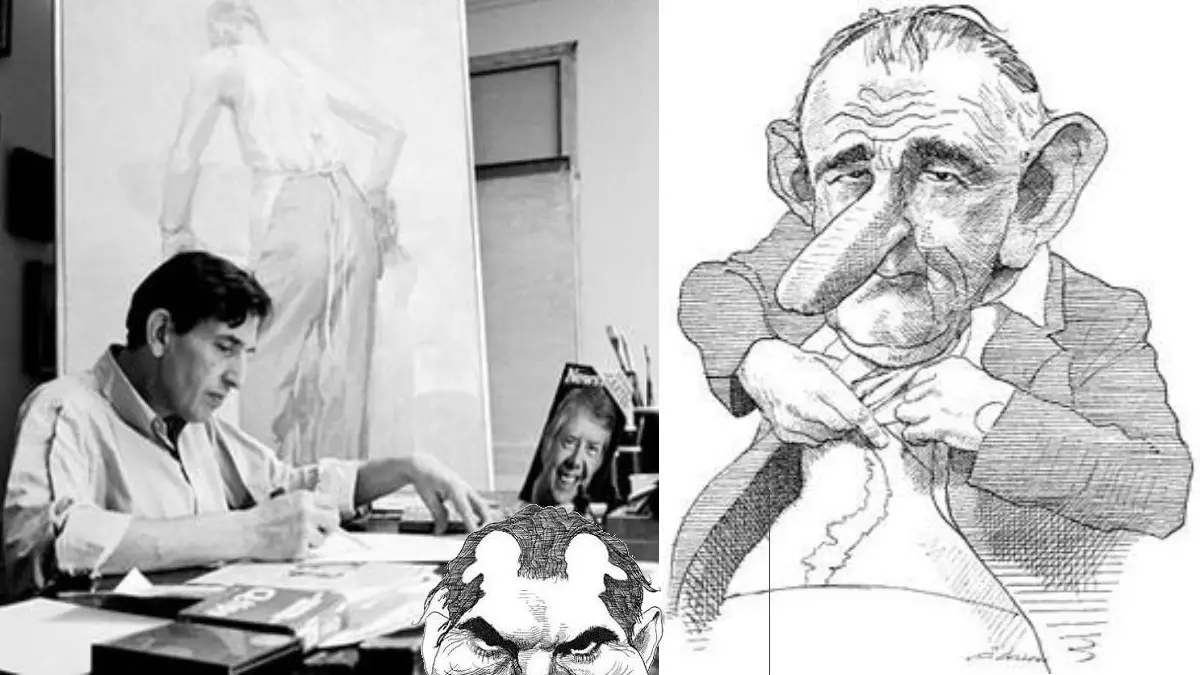
David Levine was born in Brooklyn, New York, on December 20, 1926, and died in New York City on December 29, 2009. He was a painter and draughtsman whose uncompromising caricatures made the illustrated face a form of intellectual and political argument.
Training and parallel careers
Levine studied at institutions including the Pratt Institute, the Tyler School of Art and the Art Students League. He pursued painting throughout his life, particularly watercolours of bathers and changing urban waterfronts.
Caricature brought him an international audience, but it was not a lesser occupation beside painting. Both practices depended on disciplined looking, confident drawing and the ability to organize complex information with economy.
A face as critical interpretation
Levine studied photographs, gestures, public reputations and the context in which an image would appear. He enlarged a nose, compressed a body or transformed a familiar attribute, but retained likeness through structural accuracy.
The distortion therefore did more than provoke laughter. It proposed an interpretation of ambition, vanity, intelligence or authority and invited readers to disagree.
Presidents, writers and public power
This English-language presentation surveys Levine’s depictions of American presidents alongside selected paintings. Seeing the two bodies of work together challenges the assumption that the caricatures were effortless jokes detached from a serious visual education.
The New York Review of Books
From the 1960s onward, Levine produced thousands of drawings for The New York Review of Books. Writers, artists, generals, economists and politicians entered the same republic of scrutiny. His images did not simply illustrate articles; they supplied a parallel editorial voice.
Pen and ink suited the publication format, yet limitations encouraged invention. A few lines had to preserve recognition, reproduce clearly and carry an argument at small scale.
Levine within American caricature
This English-language film places David Levine within the broader art of American caricature. It demonstrates how editorial drawing can condense biography and political history into one memorable visual proposition.
Humour, ethics and historical context
Caricature always risks turning physical difference into cruelty or stereotype. Levine’s strongest drawings direct exaggeration toward conduct and power, but responsible viewing still requires attention to the conventions and prejudices of their moment.
That ethical tension is part of the medium’s history. Satirical freedom gains force when viewers can distinguish criticism of public action from contempt for vulnerability.
The legacy of David Levine
Levine elevated editorial illustration by joining technical command with independent judgement. His drawings remain models for artists seeking to make an image think rather than decorate. They also preserve a densely populated visual chronicle of twentieth-century politics and culture, filtered through one sceptical and unmistakable hand.