Constantin Brancusi: Form, Material and the Essence of Sculpture
Constantin Brancusi transformed modern sculpture through direct carving, polished surfaces and radically simplified forms rooted in craft, nature and spiritual reflection.
- Constantin Brancusi
- modern sculpture
- Romanian art
- direct carving
- Bird in Space
- The Kiss
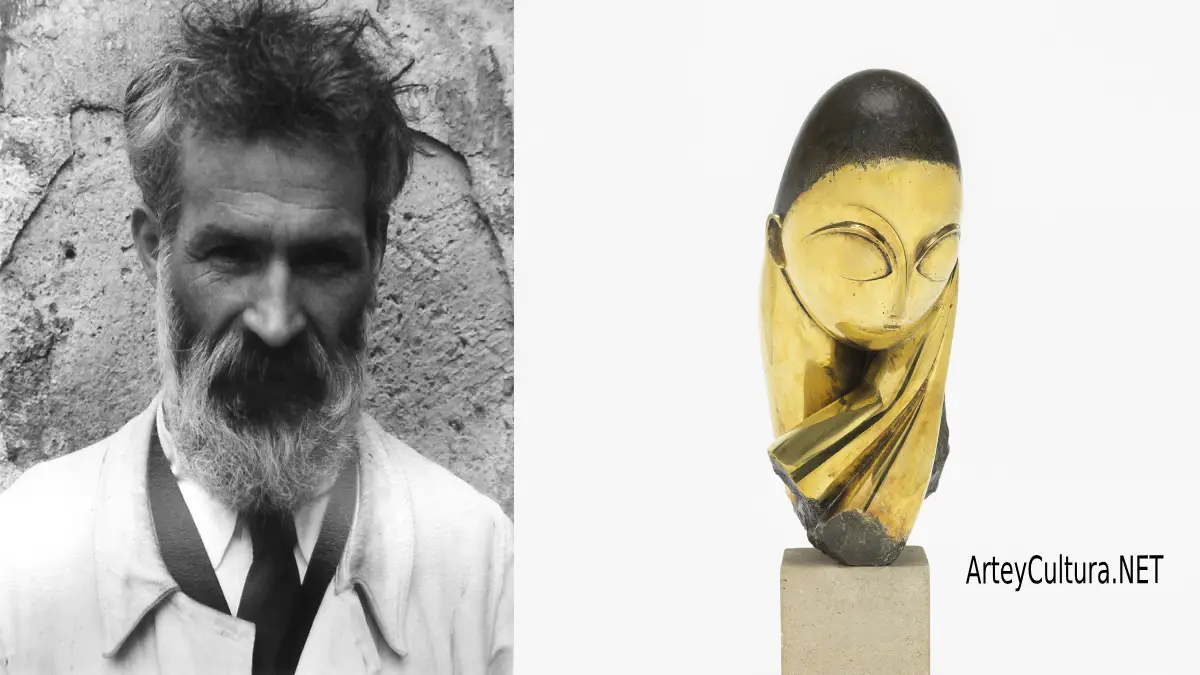
Constantin Brancusi was born in Hobita, Romania, on February 19, 1876, and died in Paris on March 16, 1957. His concentrated forms changed the direction of twentieth-century sculpture, showing that simplification could intensify rather than diminish meaning.
From rural Romania to Paris
Brancusi grew up among the carved wooden gates, tools and domestic objects of the Romanian countryside. He trained at arts and crafts schools in Craiova and Bucharest before walking much of the way to Paris in 1904.
He briefly entered Auguste Rodin’s workshop, yet soon left. Brancusi wanted to discover a sculptural language through his own sustained contact with wood and stone rather than remain under the influence of an established master.
Direct carving and the intelligence of materials
Instead of treating sculpture merely as the reproduction of visible anatomy, Brancusi sought the defining rhythm of a subject. He carved directly, preserved traces of the block and made bases integral to the work. Marble, limestone, wood and polished bronze each contributed a distinct visual and tactile character.
The apparent simplicity of his art resulted from repeated refinement. Oval heads, ascending columns and streamlined birds are precise investigations of balance, light, weight and movement.
Understanding Brancusi’s language
This English-language presentation examines how Brancusi moved beyond realistic description without abandoning the natural world. It is useful for seeing how materials, bases and surrounding space participate in the sculpture.
Essential works
The Kiss compresses two embracing bodies into a compact block, making union legible through geometry. The sleeping heads and portraits of women refine the oval into an image of inwardness. In the many versions of Bird in Space, a bird is evoked not through wings and feathers but through an elongated, rising contour.
His memorial ensemble at Targu Jiu, completed in the 1930s, joins the Table of Silence, the Gate of the Kiss and the Endless Column along a ceremonial axis. The project honours Romanian soldiers while turning passage, gathering and vertical ascent into a public experience.
Bird in Space and a modern definition of art
This English Smarthistory discussion focuses on Bird in Space. It explains the relation between abstraction and motion and recalls the famous customs dispute that forced authorities to consider whether a nonrepresentational object could legally be classified as art.
The legacy of Constantin Brancusi
Brancusi established the studio as a complete environment in which sculptures, bases, tools, photographs and light formed a carefully considered whole. He also photographed his own work to control how its surfaces and spatial relationships were understood.
His legacy reaches Minimalism, abstract sculpture, installation and contemporary debates about craft. Above all, he demonstrated that a reduced form can carry memory, physical presence and poetic force without becoming empty decoration.