David Hockney: Seeing Space and Time Anew
The life, California paintings, photo collages, landscapes and digital experiments of David Hockney, a British artist devoted to renewing the act of seeing.
- David Hockney
- British art
- California painting
- photographic collage
- digital drawing
- landscape
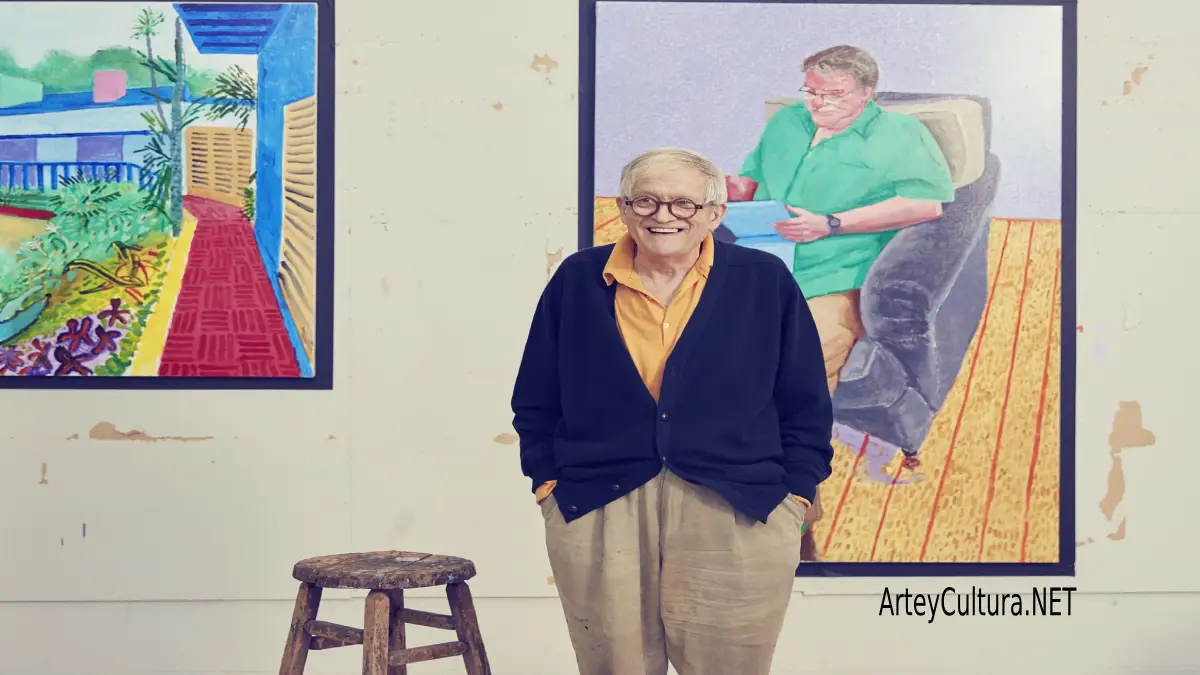
David Hockney was born in Bradford, England, on July 9, 1937. Painter, draughtsman, printmaker, photographer and stage designer, he has spent his career asking how an image can represent a world that is seen through movement and time.
Bradford, London and early visibility
Hockney studied at Bradford College of Art and the Royal College of Art. He emerged in the early 1960s alongside British Pop art, although his autobiographical subjects and persistent commitment to drawing resist a single label.
His openness about being gay entered the work when homosexual acts between men were still criminalised in Britain. Personal desire became visible without being reduced to confession.
California light and constructed space
Moving between Britain and Los Angeles brought swimming pools, modern houses and brilliant light into paintings such as A Bigger Splash. Their apparent clarity is carefully staged: flat colour, rippling water and geometric architecture create tension between presence and absence.
Double portraits place people within rooms whose furniture and distances carry psychological meaning. Perspective often feels plausible until close looking reveals several viewpoints.
Watching Hockney make a landscape
This English video follows Hockney’s process and shows how drawing and colour organise a landscape. The work grows through repeated observation rather than copying one frozen optical instant.
Photography and many moments
In the 1980s, Hockney made composite photographs or “joiners” from many snapshots. Edges fail to align perfectly because the camera and subject changed between exposures.
These seams are the point: ordinary vision also moves, selects and remembers. A single photograph’s fixed viewpoint is one convention, not neutral truth.
New tools, old questions
In this English conversation, Hockney discusses technology and looking. Fax, video, iPhone and iPad became working tools because each opened another relation between mark, sequence and distribution.
Achievement and legacy
Hockney connects the history of painting with continuous experiment. His legacy is a generous scepticism toward fixed vision: every tool can make us look again, provided novelty remains in service of attention.