
Rolph Scarlett: Geometry, Colour and Non-Objective Art
The design career, abstract painting, Guggenheim connection and rediscovery of Rolph Scarlett, a Canadian-born artist who built dynamic systems from colour and form.
- Rolph Scarlett
- abstract art
- non-objective painting
- Guggenheim
- Canadian American art
- geometric abstraction
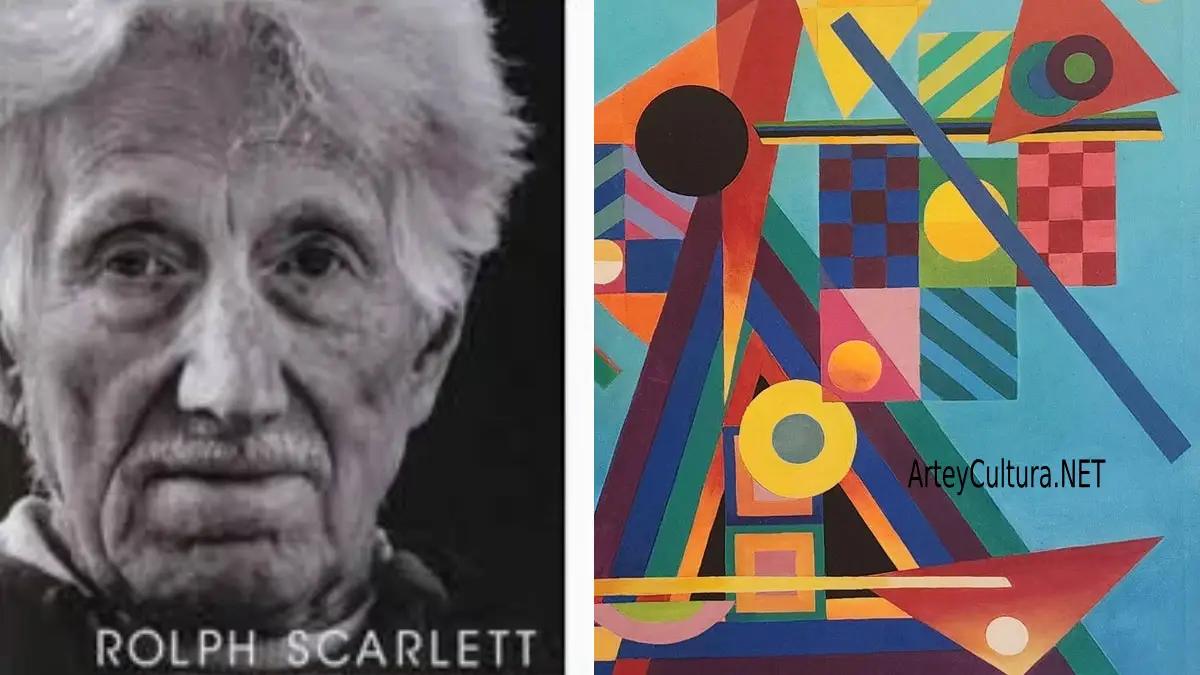
Rolph Scarlett was born in Guelph, Ontario, on August 13, 1889, and died in Woodstock, New York, on April 18, 1984. Painter, designer and jewellery maker, he became an important early contributor to non-objective art in the United States.
Design before full-time painting
Scarlett worked in jewellery, theatrical design and industrial settings before concentrating on fine art. These fields trained him to organise shapes as functional relationships rather than as isolated decorative motifs.
His route complicates the idea that modern abstraction developed only inside painting academies. Practical design and stage space offered their own laboratories of colour, movement and structure.
From representation to abstraction
Scarlett experimented with several styles before developing compositions built from circles, bars, arcs and planes of colour. Although the vocabulary is geometric, the paintings rarely feel static.
Forms approach, overlap and pull away. Visual balance remains provisional, giving the surface something like musical rhythm without depicting a recognisable object.
An exhibition in San Francisco
This English presentation of a Scarlett exhibition shows works across the gallery wall. Seeing multiple compositions together reveals recurring forms and substantial variation within his abstract language.
Hilla von Rebay and the Guggenheim circle
Hilla von Rebay, an advocate of non-objective art and formative director of Solomon R. Guggenheim’s museum, supported Scarlett. Guggenheim acquired a significant group of his paintings.
Scarlett became closely associated with the Museum of Non-Objective Painting, predecessor of the Solomon R. Guggenheim Museum. That institutional connection gave his work visibility but also linked its later reputation to changing narratives around the collection.
Beyond geometry alone
Not all of Scarlett’s work belongs to one strict system. He also explored biomorphic and more freely gestural forms. The shifts show an artist testing how far abstraction could move while still preserving internal coherence.
His jewellery and design work reinforce the same concern: a line or plane gains meaning through relation, scale and physical placement.
Seventy-five years of abstraction
This English documentary surveys Scarlett’s long career and Guggenheim connection. It is useful for recovering an artist frequently omitted from condensed histories of American abstraction.
Achievement and legacy
Scarlett helped establish a public space for non-objective art before post-war American abstraction achieved dominance. His renewed visibility demonstrates that art history is not a fixed list: exhibitions, archives and scholarship continually restore complex careers to view.