Mary Blair: Colour and Imagination in Modern Animation
The life, concept art, books and design legacy of Mary Blair, whose bold colour shaped Disney films and the visual world of It's a Small World.
- Mary Blair
- animation design
- Disney concept art
- colour design
- It's a Small World
- illustration
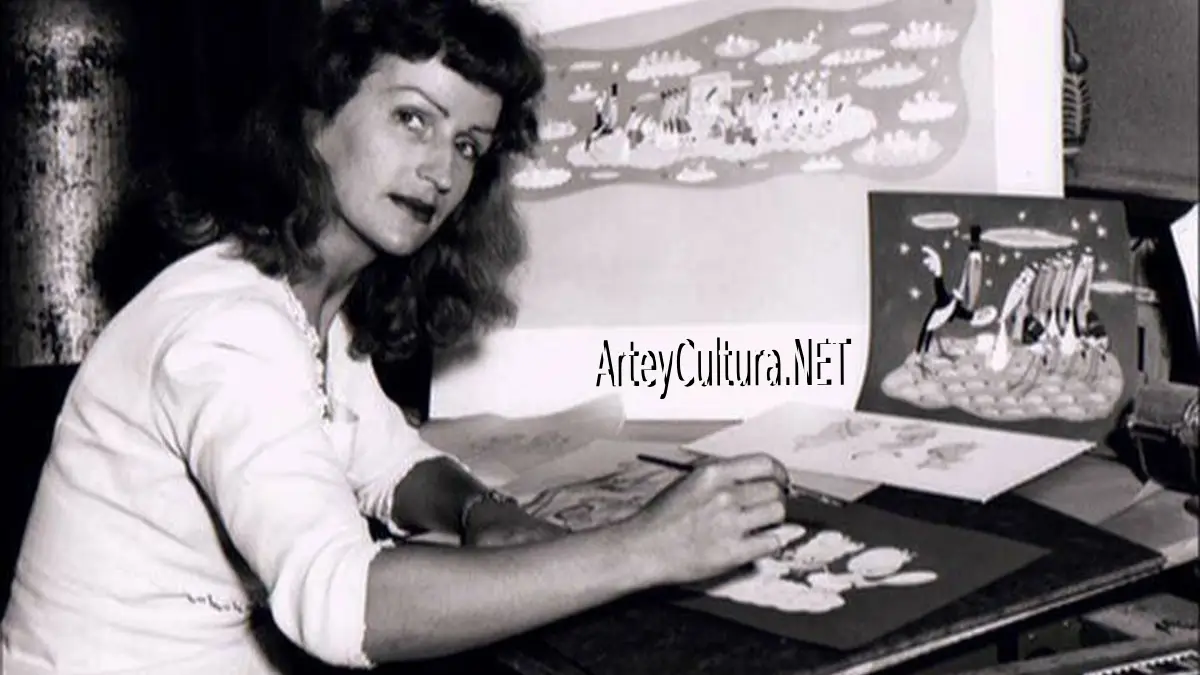
Mary Blair, born Mary Browne Robinson in McAlester, Oklahoma, on October 21, 1911, died in Soquel, California, on July 26, 1978. Painter, illustrator and concept artist, she helped establish colour development as a central creative force in animated filmmaking.
Education and early animation work
Blair studied at the Chouinard Art Institute in Los Angeles on scholarship. She married artist Lee Blair and worked at animation studios before joining Walt Disney Productions.
Her fine-art interests did not disappear inside commercial work. Modern painting, folk art and children’s illustration informed a visual language based on simplified geometry, surprising scale and carefully controlled palettes.
The South American journey
In 1941, Blair joined Walt Disney and other studio artists on a research trip through parts of Latin America. Her watercolours from the journey impressed Disney and influenced Saludos Amigos and The Three Caballeros.
The trip expanded her palette and strengthened her role at the studio. It also belongs to the complex history of United States cultural diplomacy during the Good Neighbor era.
Bringing Alice artwork into motion
This language-neutral animation of Blair’s Alice in Wonderland concept art shows how strongly her still images imply movement. Changes of scale, angled pathways and concentrated colour already direct the eye before final character animation begins.
Designing emotion before animation
Blair produced influential concept work for Cinderella, Alice in Wonderland and Peter Pan. Her images established mood, spatial logic and emotional rhythm for teams that later translated them into finished sequences.
Concept art is not simply preliminary decoration. It gives a production a shared visual hypothesis. Although final films often softened Blair’s abstraction, her palettes and environmental ideas remain fundamental to their identity.
Books, murals and a global attraction
After leaving full-time studio work, Blair illustrated children’s books, designed advertisements and created large architectural pieces. Her best-known public project is the visual design for It’s a Small World, first created for the 1964 New York World’s Fair.
The attraction uses repeated forms, flat patterns and changing regional palettes to organise an enormous moving environment. Its apparent simplicity depends on sophisticated decisions about legibility, rhythm and scale.
A Disney dedication
This English-language tribute connects Blair with It’s a Small World and the studio colleagues who translated her designs into three-dimensional space. It also makes visible the collaborative nature of animation and themed environments.
Achievements and legacy
- She made colour scripting and concept design more visible within animation production.
- Her work shaped several of Disney’s defining mid-century features.
- She carried the same language into books, advertising, murals and environmental design.
- Her rediscovery helped restore a woman artist’s authorship within studio history.
Mary Blair’s legacy shows that a film’s emotional world begins long before characters move. Colour, shape and scale can tell the story first.