Dalí and Disney: The Interrupted Journey of Destino
The conception, abandonment, reconstruction and legacy of Destino, the animated short that brought Salvador Dalí's Surrealism into Walt Disney's studio.
- Salvador Dalí
- Walt Disney
- Destino
- animation history
- Surrealism
- short film
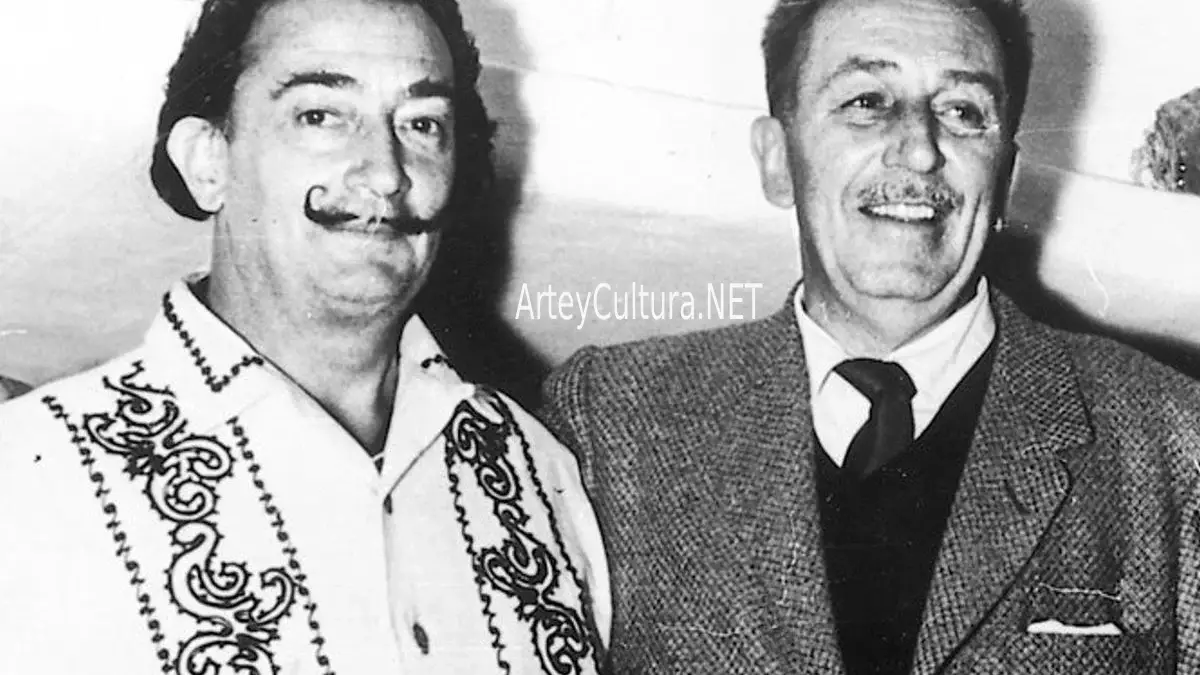
In 1945, the Spanish Surrealist Salvador Dalí and American producer Walt Disney began an unlikely collaboration. Their project, Destino, sought to join Dalí’s metamorphic imagery with the narrative movement and technical resources of a major animation studio.
Two public imaginations meet
Dalí had long been interested in cinema and had collaborated with Luis Buñuel and Alfred Hitchcock. Disney, meanwhile, wanted animation to engage more openly with modern art and had already experimented with music-driven forms in projects such as Fantasia.
The collaboration was not simply a meeting between “high art” and popular entertainment. Both men understood the power of carefully constructed public personas and both worked through large networks of technical collaborators.
John Hench and the visual development
At the Disney studio, Dalí worked closely with artist John Hench. Together they produced drawings, paintings, story concepts and a short animation test. Bodies, shadows, architecture and desert landscapes continually transform into one another.
The project used the song Destino by Mexican composer Armando Domínguez. Its loose narrative concerns an impossible love between a mortal woman and Chronos, the personification of time.
The completed short film
This language-neutral presentation of the film communicates primarily through music and image. Familiar Dalí motifs—melting forms, ants, barren spaces and unstable bodies—become fluid events rather than static painted symbols.
Why production stopped
The studio abandoned the project in 1946. Post-war financial pressures and changes in Disney’s production strategy made an experimental short difficult to justify. For decades, the surviving paintings, sketches and brief test sequence were evidence of a film that might never exist.
Its incompletion also created a historical problem. Were the materials an autonomous archive, a plan awaiting fulfilment or fragments that should remain unfinished?
Reconstruction and release in 2003
Roy E. Disney, Walt Disney’s nephew, revived the project. A team led by French animator Dominique Monfery studied the surviving artwork and story material, combining hand-drawn animation with digital tools.
The six-minute film premiered in 2003, nearly six decades after conception. It received an Academy Award nomination for Best Animated Short Film.
A surreal friendship explained
This English account places the collaboration within the lives and ambitions of Dalí and Disney. It helps distinguish the documented production history from the mythology that naturally grew around two famous names.
Achievements and legacy
- Destino created a rare direct collaboration between a Surrealist painter and a Hollywood animation studio.
- The surviving archive made a historically informed completion possible.
- The final film translated Dalí’s metamorphoses into continuous animated movement.
- Its history raises valuable questions about authorship, restoration and completing unfinished art.
The film’s fascination lies partly in its temporal split. Conceived in 1945 and completed in 2003, Destino belongs to both moments and fully to neither—an appropriate fate for a story about desire pursued through time.