Gerardo Chávez: Matter, Imagination and Peruvian Memory
The life, visual language, major series and cultural work of Gerardo Chávez, the Peruvian painter and sculptor who founded two museums in Trujillo.
- Gerardo Chávez
- Peruvian art
- Latin American painting
- Trujillo
- surrealism
- Museo de Arte Moderno
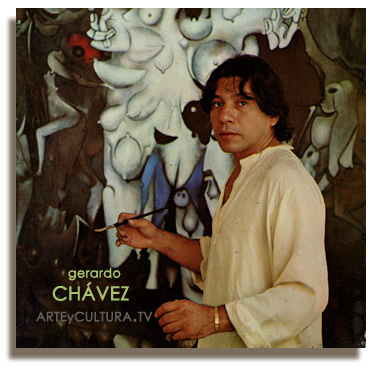
Gerardo Chávez López was born in Trujillo, Peru, on November 16, 1937. Painter, sculptor and cultural promoter, he developed a world of fantastic beings, masks, processions and hybrid bodies in which Andean memory, popular culture and social unease converge.
Education and the European encounter
Chávez graduated from Peru’s National School of Fine Arts in 1959. He then travelled to Europe and lived or worked in Italy, France and Belgium. Museums and contact with Expressionism and Surrealism expanded his visual vocabulary without erasing his relationship to northern Peru.
His work cannot be reduced to a European movement. Pre-Columbian forms, Catholic processions, toys, labour and collective memory enter a language shaped by travel but rooted in Peruvian experience.
A surface built from matter
Chávez frequently added sand, clay, burlap and other materials to paint. These dense surfaces make the image feel excavated or weathered. Creatures seem to emerge from the support rather than merely rest upon it.
Distortion serves several purposes. It can be comic, unsettling or ceremonial, and often all three at once. Crowds become theatres in which power, survival and imagination are negotiated.
Half a century of creation
This Spanish-language Peruvian profile follows the artist through works from different periods. It is especially useful for seeing scale and texture, qualities easily flattened in small reproductions.
Major cycles and recurring figures
Chávez began The Metamorphosis of Water in 1973. Later bodies of work include The Other Ekeko, The Potato Procession, Little Horses of the Soul and Automata of the Carousel.
These are not isolated inventions. The Ekeko invokes an Andean figure of abundance, the potato connects food with land and labour, and carousel figures join childhood wonder to repetition and control. Chávez repeatedly turns cultural symbols into open, contemporary questions.
Building museums in Trujillo
His contribution extends beyond his studio. Chávez founded the Toy Museum, inaugurated in 2001, and the Museum of Modern Art of Trujillo, opened in 2006. The first preserves objects that reveal childhood and social history; the second created a significant home for modern and contemporary art outside Lima.
Together, the institutions decentralise cultural access and show that collecting, preserving and educating can form part of an artist’s public practice.
The Potato Procession
This Spanish-language presentation approaches one of Chávez’s emblematic subjects. The humble crop becomes the centre of a dense procession, linking celebration, sustenance, work and Andean identity.
Achievements and legacy
- He established an internationally recognised visual language grounded in Peruvian memory.
- He joined painting and sculpture through unusually physical surfaces and hybrid forms.
- He created two lasting museums in his native Trujillo.
- He demonstrated that an artist can also shape the institutions through which a community encounters culture.
Gerardo Chávez’s legacy lies in that union of imagination and responsibility. His fantastic beings open a space for historical memory, while his museums give that space a durable civic form.