Rene Magritte: Images, Words and Everyday Mystery
The life, paintings and legacy of Rene Magritte, the Belgian Surrealist who turned familiar objects into precise and unsettling questions about reality.
- Rene Magritte
- Surrealism
- Belgian art
- The Treachery of Images
- conceptual art
- modern painting
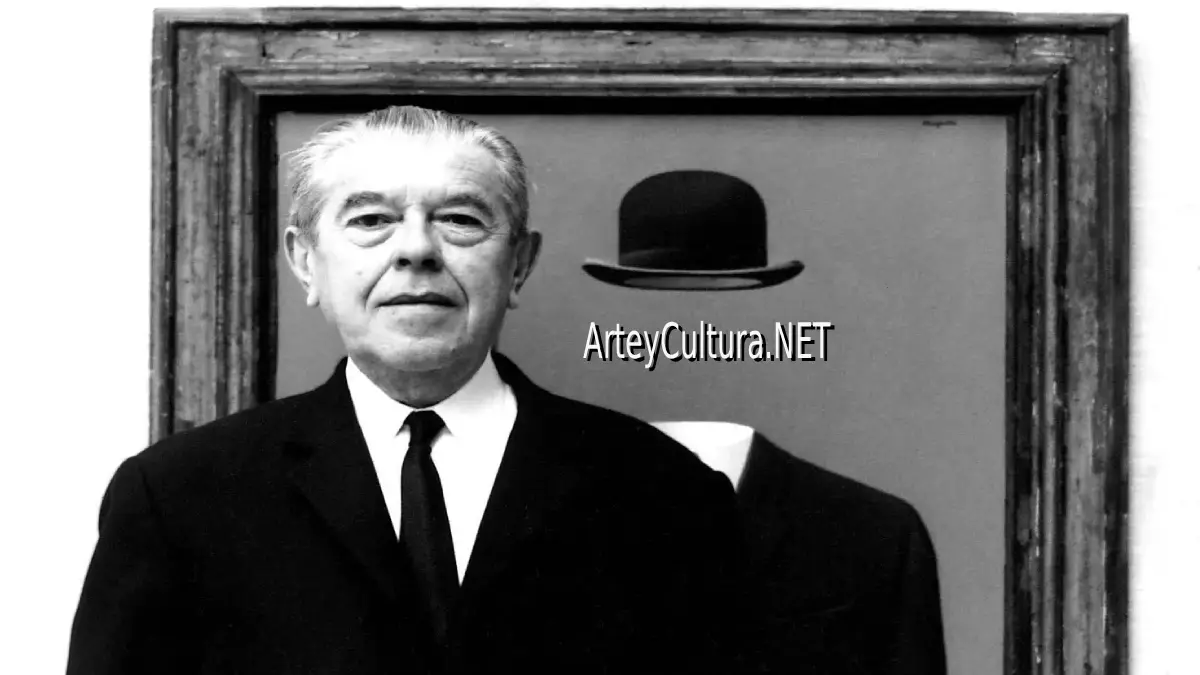
Rene Francois Ghislain Magritte was born in Lessines, Belgium, on November 21, 1898, and died in Brussels on August 15, 1967. He gave familiar things—pipes, apples, windows, birds and bowler hats—new relationships that make ordinary reality appear suddenly uncertain.
Training and commercial work
Magritte studied at the Academie Royale des Beaux-Arts in Brussels. Before living entirely from painting, he designed wallpaper, advertisements and printed material. That experience helps explain the clean contours, legible objects and deliberate relationship between words and images in his mature art.
His method differs from the automatic gestures associated with some Surrealists. Magritte normally painted with controlled technique because mystery depended on making an impossible scene look calm and immediately recognisable.
Discovering a visual problem
The metaphysical paintings of Giorgio de Chirico showed Magritte that an image could create poetry by rearranging ordinary reality. During a period in Paris from 1927 to 1930, he joined the wider Surrealist circle, yet retained the distinctive intellectual character of Belgian Surrealism.
He did not simply illustrate dreams. He constructed visual propositions: a night street beneath a daylight sky, a room occupied by an enormous apple, or a landscape apparently continuing through a canvas placed before it.
The man behind the bowler hat
This English documentary places Magritte’s restrained public appearance beside the disruptive logic of his paintings. The contrast matters: extraordinary images did not require an extravagant artistic persona.
“This is not a pipe”
In The Treachery of Images, a carefully painted pipe appears above the sentence Ceci n’est pas une pipe. The statement is correct: the viewer sees a representation, not an object that can be filled with tobacco. Image, word and thing refer to one another, but they are never identical.
Magritte returned to this problem throughout his career. His work asks us to notice how quickly we confuse labels and pictures with the reality they claim to describe.
Motifs that change through repetition
Apples, curtains, clouds, flames, windows, covered faces and anonymous men recur across many works. Repetition does not fix their meaning. A motif changes according to scale, location and combination, preventing a single symbolic dictionary from closing the question.
Surrealism explained through the paintings
This English overview compares several recurring strategies. Seen together, the works reveal how substitution, impossible scale and the contradiction between interior and exterior became parts of Magritte’s visual grammar.
Achievements and legacy
- He made the relationship between language and representation a central artistic subject.
- He created some of modern art’s most recognisable images without sacrificing ambiguity.
- His ideas influenced Pop art, conceptual art, advertising, photography, cinema and album design.
- He demonstrated that precise realism can be used to question reality rather than merely imitate it.
Magritte’s lasting achievement is the productive doubt his paintings create. We recognise every object, yet the whole scene refuses to settle into common sense.