The Prado Mona Lisa: A Copy Painted Beside Leonardo's Original
The technical study and restoration of the Prado Mona Lisa, a workshop version produced alongside Leonardo's painting and revealed in 2012.
- Prado Mona Lisa
- Leonardo da Vinci
- Mona Lisa
- Museo del Prado
- painting conservation
- infrared reflectography
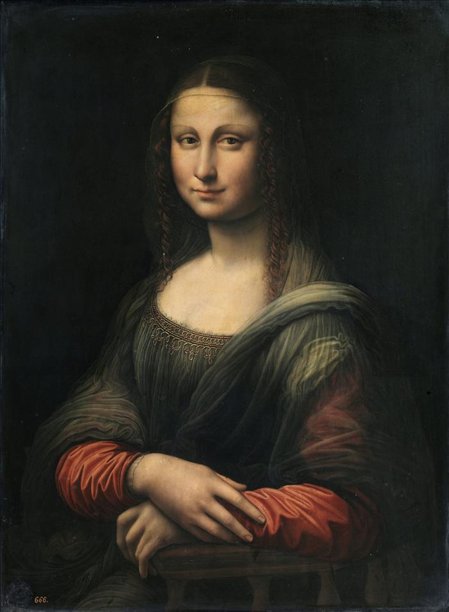
The Prado Mona Lisa is a version of Leonardo da Vinci’s celebrated portrait made within his workshop. Research and conservation presented in 2012 demonstrated that it was not a much later imitation: an assistant appears to have worked beside Leonardo while the Louvre painting was developing.
A copy hidden by later alterations
For many years a dark overpaint concealed the landscape and flattened the space behind the sitter. The panel was valued as evidence of Leonardo’s influence but regarded as a secondary repetition with limited independent importance.
Technical examination changed that interpretation. Once conservators understood that the black background was not original, careful removal could recover the landscape without erasing historical paint belonging to the first composition.
Infrared evidence of a shared process
Infrared reflectography reveals carbon-rich underdrawing beneath visible paint. The Prado panel contains changes corresponding to alterations under the Louvre Mona Lisa. When Leonardo adjusted features, the workshop painter followed similar decisions.
This pattern is more informative than simple resemblance. It places both panels in the same evolving process and provides rare material evidence of how Leonardo’s workshop operated.
The discovery explained
This English Associated Press report introduces the scientific findings and conservation. Its concise comparison clarifies why the work matters without presenting it as a second autograph Leonardo.
Restoring the landscape
Removal of the later black layer revealed mountains, paths and atmospheric colour related to the Louvre background. The sitter now appears younger and more spatially present because cool colour relationships are no longer filtered through heavy darkness.
Conservation did not make the picture new. Tests, imaging and documentation limited intervention to what evidence supported. Every removal carried the responsibility of distinguishing later alteration from original workshop material.
Before and after treatment
This English comparison shows how dramatically overpaint can alter meaning. It also demonstrates why a restoration photograph should be read as the outcome of research, not as a cosmetic makeover.
Who painted it?
Names including Francesco Melzi and Salai have been proposed, but no attribution is proven. The rigorous description remains Leonardo’s workshop. An anonymous maker can still provide exceptional historical knowledge.
Achievement and significance
- The panel documents decisions made while Leonardo’s original was in progress.
- Technical imaging revealed a shared sequence invisible to ordinary viewing.
- Conservation restored the spatial and chromatic role of the landscape.
- The work offers evidence about collaboration in a Renaissance workshop.
The Prado Mona Lisa ceased to be merely a shadow of a masterpiece. Its importance lies precisely in being a copy: a material witness to observation, learning and simultaneous work beside Leonardo.