Jackson Pollock: Gesture, Material and Pictorial Space
The life, controlled pouring technique and legacy of Jackson Pollock, a central figure of Abstract Expressionism whose paintings record movement and time.
- Jackson Pollock
- Abstract Expressionism
- drip painting
- action painting
- Lee Krasner
- American art
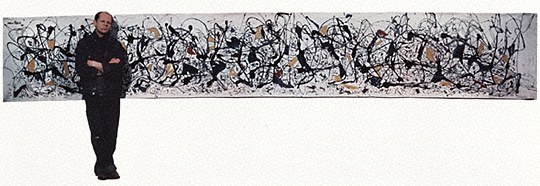
Paul Jackson Pollock was born in Cody, Wyoming, on January 28, 1912, and died in Springs, New York, on August 11, 1956. His poured paintings expanded the meaning of pictorial composition by registering gravity, sequence, bodily movement and the changing behaviour of liquid material.
Formation before abstraction
Pollock studied with Thomas Hart Benton in New York. Benton’s regionalist subject matter did not remain his model, but its rolling compositional rhythms left a lasting trace. Mexican muralists, Indigenous art encountered through museums, European modernism and Surrealist automatism also entered his development.
Work for the Federal Art Project offered income during the Depression. Psychiatric treatment and recurring alcoholism accompanied his early career, but neither illness nor intoxication explains the discipline visible in the paintings.
Moving the canvas to the floor
From around 1947, Pollock laid large unstretched canvases on the studio floor. He poured, dripped and flicked commercial paint using sticks, hardened brushes and containers. Working from all sides allowed lines to cross the image without obeying a conventional top or central figure.
The method contained chance, but it was not random. Viscosity, height, speed, hand direction and drying time altered every mark. Pollock paused, evaluated and returned until density and interval held together.
Pollock working in 1951
Hans Namuth’s language-neutral film offers rare direct evidence of the process. It reveals whole-body movement, but the staged act of filming also helped create the public myth of an artist defined entirely by spontaneous performance.
The all-over field
Works such as Autumn Rhythm and One: Number 31, 1950 distribute visual energy across the entire surface. The eye finds no single privileged centre. Layers establish different depths while the exposed canvas preserves breathing space.
Numbered titles reduce the pressure to discover a hidden scene and redirect attention toward material relationships. Viewers still make associations, but none becomes an official key.
Controlled, not random
This English analysis focuses on decisions within drip painting. It helps counter the common claim that anyone could reproduce the result merely by spilling paint, without replacing visual judgement with scientific certainty.
Lee Krasner and an incomplete history
Lee Krasner, Pollock’s wife, was an important Abstract Expressionist with an independent career. She provided critical support and later organised his estate, but reducing her to assistant or widow repeats the gendered exclusions of postwar art history.
Death and legacy
Pollock died at forty-four in a car crash while driving intoxicated; passenger Edith Metzger also died. The event was a preventable tragedy, not an appropriately dramatic ending for an artist.
- He made painting process visible without making composition irrelevant.
- His large all-over fields changed the physical relation between viewer and canvas.
- His methods influenced performance, installation and later material practices.
- His fame also became a case study in how media manufactures the figure of genius.
Pollock’s legacy is strongest when separated from myth. The paintings are not frozen explosions but records of sustained decisions unfolding through material, body and time.