Giovanni Battista Piranesi: Rome, Ruins and Imaginary Prisons
The life, prints and architectural imagination of Giovanni Battista Piranesi, who transformed ancient Rome and impossible prisons into modern visual experiences.
- Giovanni Battista Piranesi
- Carceri
- Vedute di Roma
- printmaking
- architecture
- Roman ruins
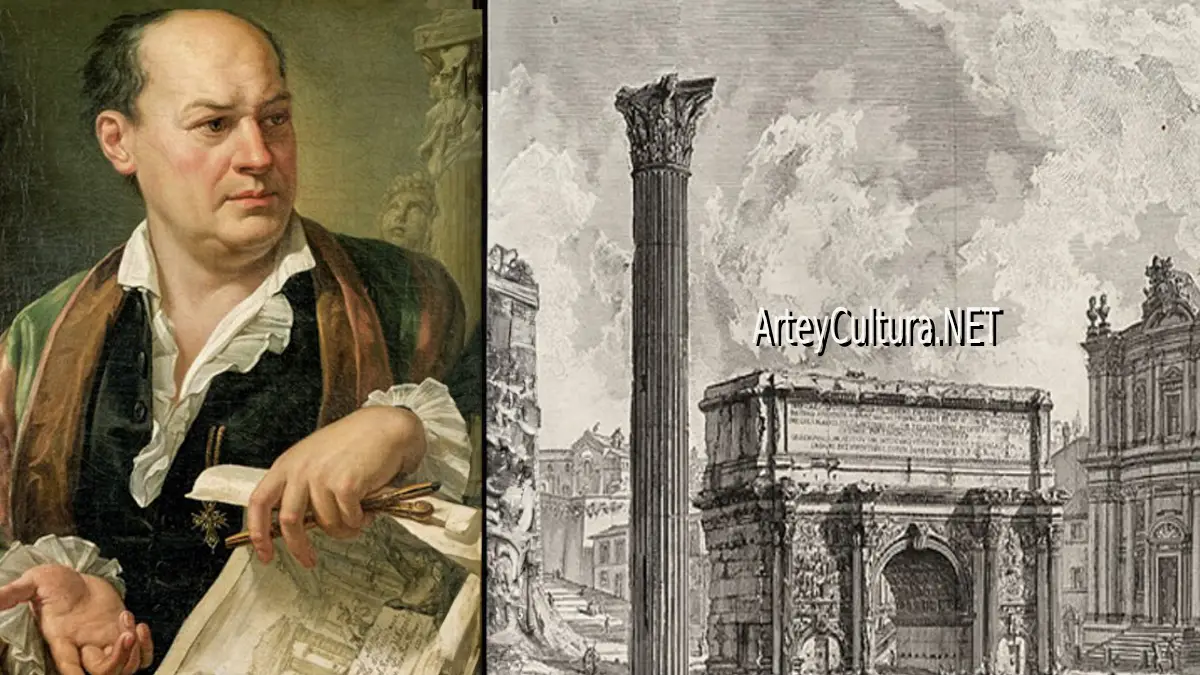
Giovanni Battista Piranesi was born in Mogliano Veneto on October 4, 1720, and died in Rome on November 9, 1778. Trained in architecture and active as an archaeologist, designer, publisher and printmaker, he produced more than a thousand etched images that changed how Europe imagined ancient and modern Rome.
Learning to construct with images
Piranesi grew up near Venice and learned principles of building, stage design and perspective. He arrived in Rome in 1740 and made the city his central subject. Few of his architectural projects were realised, but printmaking gave him another way to build: on paper, scale, light and viewpoint could transform a ruin into a monumental encounter.
His Vedute di Roma circulated among Grand Tour travellers. These views documented monuments while intensifying broken masonry, dramatic skies and tiny human figures. Buyers carried home not only a record of Rome but an emotionally enlarged idea of the city.
Mapping an architectural imagination
This English university presentation examines Piranesi’s worlds as systems of spatial thought. It demonstrates how maps, views and invented architecture operate together rather than belonging to separate documentary and fantastic careers.
The Carceri d’invenzione
The Imaginary Prisons present cavernous interiors filled with stairs, bridges, ropes, machinery and platforms. Routes multiply without leading to a stable exit. Human figures are reduced by structures that appear both engineered and impossible.
Piranesi substantially reworked the series for a later edition, deepening shadows and adding spatial complications. The changes turn an already theatrical architecture into a more oppressive psychological environment.
Inside the prisons
This English lecture from the San Diego Museum of Art guides viewers through the series and its revisions. Close comparison reveals that the apparent chaos rests on highly controlled perspective, tonal contrast and sequencing.
Archaeology and polemic
Piranesi documented Roman engineering, ornament and antiquities with intense attention. He also argued passionately for Roman creativity against theorists who granted cultural superiority to Greece. His images are therefore both records and interventions in eighteenth-century debates about civilisation and design.
Achievements and legacy
- He made the architectural print an independent work of imagination.
- His Roman views shaped European memory of ruins and the Grand Tour.
- The Carceri influenced Romanticism, Surrealism, cinema, stage design and games.
- His work joined archaeological research, publishing and visual persuasion.
Piranesi’s legacy rests on a productive uncertainty. His prints seem to document structures, yet they continually demonstrate that every city is also rebuilt by memory, desire and the act of looking.