Dante Alighieri: Exile, Poetry and the Architecture of the Afterlife
The life and legacy of Dante Alighieri, whose Divine Comedy transformed exile, politics, theology and vernacular Italian into a universal poetic journey.
- Dante Alighieri
- Divine Comedy
- Inferno
- Italian literature
- medieval poetry
- Florence
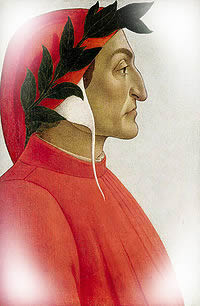
Dante Alighieri was born in Florence around 1265 and died in Ravenna during the night of September 13–14, 1321. Poet, political thinker and author of the Divine Comedy, he helped establish the Tuscan vernacular as a language capable of carrying philosophy, theology, satire and intimate experience.
Florence and the Vita Nuova
Dante belonged to a Florence divided by conflicts among factions and families. His early Vita Nuova combines prose and poetry around Beatrice, a historical woman transformed into an ethical and spiritual figure. Personal love becomes a discipline of language and self-examination.
The work participates in the dolce stil novo, a poetic movement that refined vernacular love poetry. Dante would later expand that intimate vocabulary to encompass an entire moral cosmos.
Politics and irreversible exile
As a member of Florence’s governing institutions, Dante became involved in the struggle between White and Black Guelphs. After his opponents seized power, he was condemned in 1302. Return would have exposed him to severe punishment, and he never again lived in his native city.
Exile was both wound and creative condition. Questions of justice, civic corruption, loyalty and belonging recur throughout his mature work, often through named contemporaries placed among the dead.
The world of the Divine Comedy
This English documentary introduces the poem’s journey through Hell, Purgatory and Paradise. It shows how cosmology, political history and personal memory form one carefully ordered narrative rather than three disconnected catalogues of the afterlife.
Guides, movement and moral knowledge
The pilgrim is guided first by the Roman poet Virgil, representing reason and classical wisdom, and later by Beatrice, who leads him toward theological vision. Learning occurs through encounter: the traveller hears stories, makes errors and gradually discovers that pity itself can require judgement.
The punishments of the Inferno use contrapasso, a relation between sin and consequence. Purgatory replaces fixed condition with transformation, while Paradise stretches language toward realities that the poet repeatedly says exceed representation.
Why read Dante today?
This English TED-Ed lesson explains the poem’s narrative accessibility, historical ambition and influence. It gives new readers a map without reducing the work to famous scenes of punishment.
Other works and achievements
Dante also wrote Convivio on knowledge and ethics, De monarchia on political authority and De vulgari eloquentia on vernacular language.
- He created one of world literature’s most ambitious narrative structures.
- He joined personal biography with theology and political critique.
- His use of vernacular Tuscan profoundly influenced literary Italian.
- His afterlife has shaped painting, sculpture, music, film, comics and popular culture.
Dante’s legacy is not a static medieval monument. The poem remains alive because its traveller must learn how difficult it is to see oneself, one’s enemies and one’s society with justice.