
Banksy: Anonymity, Satire and the Art Market
The work and legacy of Banksy, the British street artist who uses stencil, irony and public interventions to question authority, war and consumption.
- Banksy
- street art
- graffiti
- stencil art
- political satire
- public space
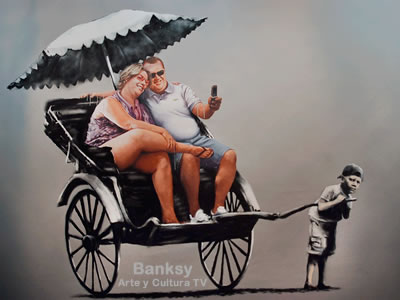
Banksy is the pseudonym of a British street artist whose identity has never been publicly confirmed. No verified birth date can therefore be stated; biographies generally connect the artist’s origins with the Bristol area. Since the 1990s, stencils, text and unexpected actions have intervened in streets, museums and the art market.
Bristol and graffiti culture
Bristol’s creative scene brought together music, design and urban writing. Banksy began with graffiti techniques and adopted stencilling, which allows an image to be prepared in advance and executed rapidly. This practical economy produced a clear silhouette and a visual language recognizable within seconds.
Images with a delayed second meaning
Children, rats, police officers, soldiers, flowers and balloons recur throughout the work. The first encounter is often comic or sentimental. A contradiction then emerges between innocence and violence, authority and absurdity, desire and consumption.
The strongest images do not require a long caption, but simplicity is not neutrality. Every selection of victim, symbol and slogan frames a political problem in a particular way.
The wall as part of the work
A street wall is never only a support. Neighbourhood, surveillance, conflict and tourism alter meaning. When a mural is removed and sold, a public intervention becomes private property, generating disputes about ownership, conservation and the community’s right to a familiar image.
A full English documentary
This English documentary surveys Banksy’s development, characteristic imagery and major public actions. It is useful not because it solves the identity mystery, but because it places anonymous authorship within a larger system of media attention, illegality and authentication.
War, borders and surveillance
Banksy has worked in places associated with military conflict and state control. A stencil can draw attention quickly, yet no symbol can replace historical knowledge of the site. The tension between immediate communication and political simplification should remain part of critical viewing.
From wall to auction room
Although Banksy’s images criticize consumerism and power, authenticated works command extraordinary prices. Property owners, galleries and auction houses participate in a market the artist mocks. Resistance itself can become a selling point, making the contradiction impossible to resolve through one spectacular gesture.
The painting that shredded itself
This concise English explanation reconstructs the 2018 auction in which a framed version of Girl with Balloon began passing through a hidden shredder immediately after sale. Instead of destroying economic value, the intervention created a new work—later titled Love Is in the Bin—whose market value increased.
The episode is an unusually clear example of the market absorbing a critique directed at it. It also shows how documentation and viral circulation can become part of an artwork’s material existence.
Authenticity and conservation
Pest Control authenticates works attributed to Banksy. For murals, conservation raises a dilemma: protective glazing can preserve an image but alter its connection with the street, while exposure accepts weathering, overpainting and disappearance as part of urban life.
Film and immersive projects
The documentary Exit Through the Gift Shop and the installation Dismaland expanded the practice into film, spectacle and institutional satire. Viewers must decide how much is document, fiction, entertainment or critique—a productive uncertainty central to the work.
Achievements and legacy
- Banksy made stencil art a global language of political satire.
- The work brought disputes about public space into contemporary art debate.
- Anonymity and media action became artistic materials in their own right.
- The practice exposes contradictions between social criticism and financial value.
Banksy remains relevant because the images move restlessly between street, screen and auction. Every relocation changes the question: who may see, own, protect or control a public image?