Transporting Art: How Works Travel Without Damage
A practical introduction to condition reports, packing, handling, climate, security and documentation in the professional transport of works of art.
- art transport
- museum practice
- art handling
- packing
- preventive conservation
- condition reports
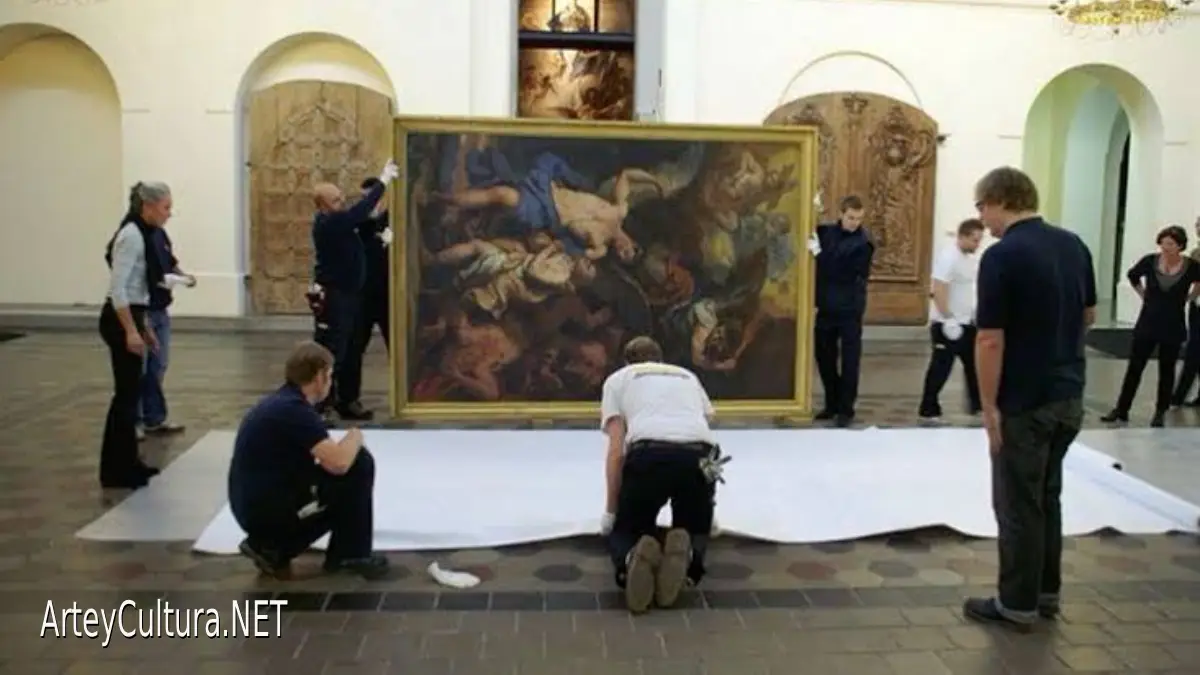
Transporting a work of art is an act of conservation. Vibration, a sudden change in humidity or one poorly coordinated movement can cause irreversible damage. Professional transport therefore begins long before an object enters a vehicle and ends only after its condition has been checked at the destination.
Assess before moving
Conservators and handlers record materials, dimensions, weight, weak points and existing damage. A painting with lifting paint may need stabilization before travel; a sculpture may have an unexpected centre of gravity. Photographs and a written condition report establish a baseline for comparison at every stage.
The assessment also identifies parts that must never bear weight. Handles, carved extensions and old frames may look strong but can fail under pressure.
Plan the route
Teams measure doors, corridors, stairways, lifts and turning spaces. They consider floor loading, working height, parking, permits and security. Measuring only the object is not enough: protective packing increases its dimensions, and a crate that fits through one doorway may not negotiate the next corner.
A clear briefing assigns roles and signals. During a difficult lift, competing instructions are themselves a hazard.
Packing a Basquiat
This English professional demonstration follows the preparation of a Basquiat painting for transport. It shows how handlers work around the object rather than touching vulnerable surfaces, add successive protective layers and coordinate each movement. The value of the film lies in its visible restraint: expertise often means knowing when not to hurry.
Packing materials and crate design
Acid-free tissues, inert barriers, suitable foams and custom crates are selected according to the object’s materials and journey. Nothing should react chemically with the work, trap dangerous moisture or press against a sensitive area. The crate is a system designed to limit shock, vibration, dust and incorrect handling—not simply a wooden box.
Reusable museum crates may incorporate suspension, insulation, handles and clear orientation marks. Packing must also be reversible: the receiving team should be able to open it without introducing a new risk.
Paintings, frames and glazing
A frame offers protection but may contain fragile ornament. Painted surfaces must never touch ordinary wrapping. Corner guards, glazing protection, moisture barriers and vibration control depend on technique, support and condition. Works behind glass may require additional measures so that breakage does not damage the image beneath.
Sculpture and three-dimensional objects
Sculpture needs calculated support points. Projecting elements cannot carry the load. Specialists may create an internal cradle that restrains movement without compression; complex works may need to be dismantled by a conservator or technician familiar with their construction.
Precious cargo in motion
This English report from DW follows the specialized logistics behind moving fine art. Vehicles, storage, tracking and trained personnel form a continuous chain of custody. The video makes clear that expensive technology cannot compensate for weak documentation or an improvised handover.
Climate and acclimatization
Wood, paper, canvas and many composite materials respond to temperature and relative humidity. Rapid change can cause warping, cracking or condensation. Climate-controlled transport and data loggers help maintain and verify stable conditions. After arrival, some crates must acclimatize before they are opened.
Security, insurance and custody
Cultural value is not identical to market price. Inventories, seals, tracking and signed transfers reduce loss and confusion. Insurance depends on accurate declarations and agreed procedures, but financial coverage cannot restore unique historical information after physical damage.
Essential principles
- Examine and document the work before and after transport.
- Plan the route, personnel, tools and emergency response.
- Design packing for the object’s materials and vulnerabilities.
- Control movement, climate, security and chain of custody.
- Avoid every unnecessary handling operation.
The best art transport leaves no visible trace on the object. Behind that apparent non-event lies a disciplined chain of knowledge, communication and care.