Mario Benedetti: Poetry, Memory and Everyday Commitment
The life, books and legacy of Mario Benedetti, the Uruguayan writer who brought poetry, fiction and political memory into close conversation with millions of readers.
- Mario Benedetti
- Uruguayan literature
- poetry
- The Truce
- Latin American exile
- Generation of 45
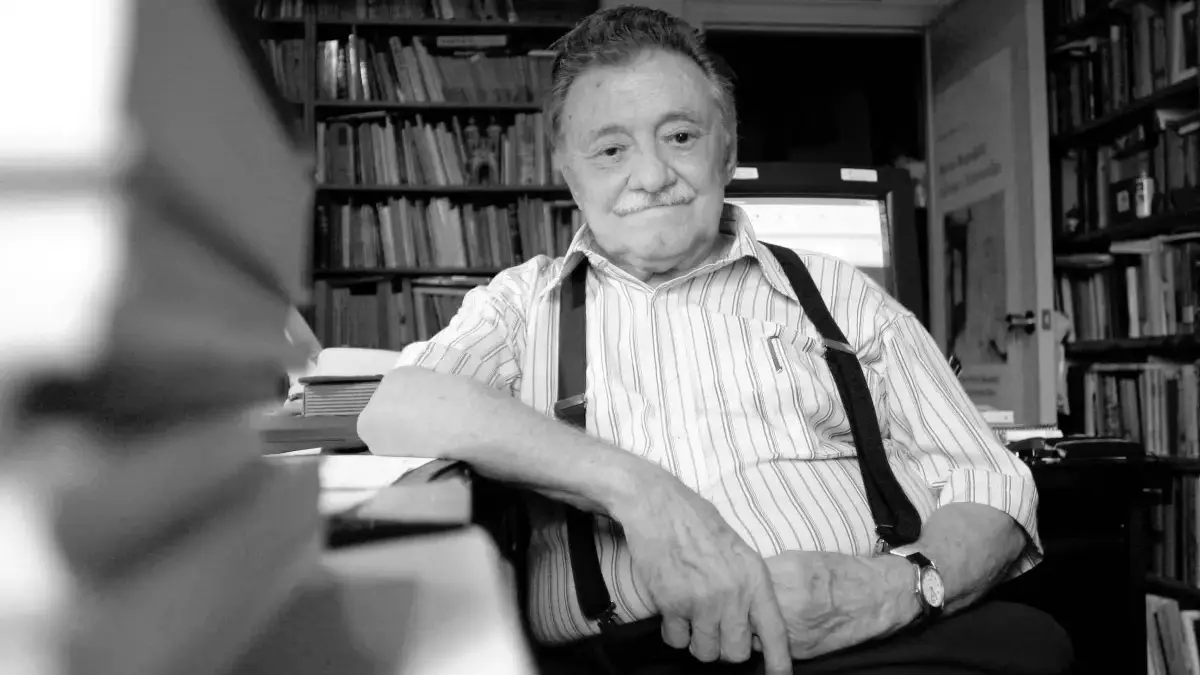
Mario Orlando Hardy Hamlet Brenno Benedetti Farrugia was born in Paso de los Toros, Uruguay, on 14 September 1920 and died in Montevideo on 17 May 2009. Poet, novelist, essayist, playwright and journalist, he published more than eighty books and formed an unusually close relationship with readers across generations.
His accessible language was never merely simple. Benedetti used rhythm, repetition and carefully controlled speech to show how love, political fear and social expectation enter the ordinary routines of work and family.
Childhood, employment and self-education
His family moved to Montevideo when he was a child. Formal education was interrupted, and from a young age Benedetti worked in offices and several other occupations. Administrative schedules, modest salaries, frustrated ambitions and small acts of resistance later became essential literary material.
The office in his writing is not a neutral background. It represents a social order that measures time while characters search for moments of freedom inside it.
The Generation of 45
Benedetti belonged to Uruguay’s Generation of 45, alongside writers such as Idea Vilariño, Juan Carlos Onetti and Ida Vitale. The group renewed criticism and literature through intellectual rigour, public debate and sustained attention to international writing.
He worked with important magazines and newspapers, combining literary creation with cultural journalism. This public dimension helped him develop a clear style capable of reaching readers beyond specialised circles.
The Truce and the drama of routine
Published in 1960, The Truce takes the form of the diary of Martín Santomé, a widower approaching retirement whose routine changes when he falls in love. A seemingly grey office life becomes a universal drama about time, renewal and loss.
The novel travelled widely through translations and adaptations for cinema, theatre, radio and television. Its emotional force comes from restraint: happiness appears as a temporary opening rather than a permanent reward.
A reluctant optimist
This English-language event from Instituto Cervantes London examines Benedetti’s literary “strange creature”, a body of work that moves freely among poetry, fiction, criticism and song. The extended discussion gives English-speaking readers historical and literary context beyond a handful of widely circulated quotations.
A poetry of closeness
Benedetti’s poems address love, friendship, fear, exile and civic responsibility in a voice that seems to speak directly to one reader. That intimacy depends on craft. Repeated phrases create momentum, conversational turns conceal formal control and humour prevents emotion from becoming solemn.
The popularity of these poems sometimes encouraged false attributions online. Reading the books rather than isolated images is important for recovering the range and precision of his actual work.
Dictatorship, exile and “desexile”
After Uruguay’s 1973 coup, Benedetti left the country and lived in Argentina, Peru, Cuba and Spain. Political persecution and repeated relocation fractured his personal life. Exile became both a historical condition and a daily experience of language, distance and interrupted belonging.
He later coined the term desexile for the difficult return. Coming home did not simply reverse departure: the country, the returning person and those who had remained were all changed.
“Do Not Save Yourself” in English
This English translation and reading of “No te salves” introduces the poem’s urgent address without sending the reader outside the article. Its accumulating commands show how Benedetti turns an intimate appeal into an argument against emotional withdrawal and passive safety.
Fiction, essays, theatre and song
Beyond poetry and the novel, Benedetti wrote short stories, criticism, humour and drama. Musicians frequently set his texts to music. His collaboration with Joan Manuel Serrat on El sur también existe demonstrated how naturally the verse could enter song while retaining literary density.
This movement among forms was part of his commitment to circulation. Literature belonged in books, but also in theatres, recordings, public readings and collective memory.
Final years and public farewell
After democracy returned, he divided his time between Montevideo and Madrid before settling again in Uruguay. He continued publishing into old age and died at 88. His public funeral reflected a society’s recognition of a writer who had accompanied private lives and national history.
Achievements and legacy
- He published more than eighty books across multiple genres.
- He transformed urban routine into enduring literary material.
- He gave poetic form to the Latin American experience of exile and return.
- He reached a mass readership without abandoning critical commitment.
- His writing inspired major film, theatre and musical adaptations.
Mario Benedetti endures because he wrote with demanding closeness. His work suggests that love, politics and hope are not abstract ideas: they are decided through the ordinary gestures of each day.