Leonora Carrington: Imagination, Rebellion and Alchemy
The life, paintings, fiction and legacy of Leonora Carrington, the British-born Mexican artist who created an independent surrealist universe.
- Leonora Carrington
- surrealism
- Mexican art
- British artist
- women artists
- fantastic literature
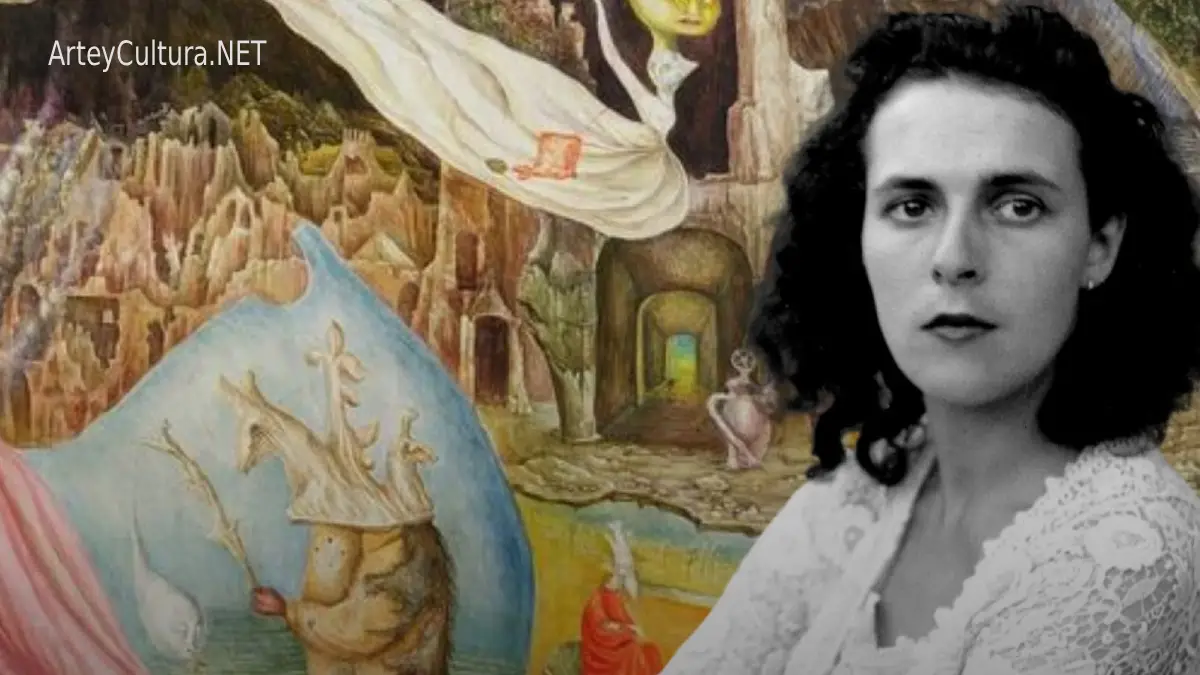
Leonora Carrington was born in Clayton Green, Lancashire, on 6 April 1917 and died in Mexico City on 25 May 2011. Painter, sculptor and writer, she rejected the role of surrealist muse and built an intellectual and imaginative world of animals, kitchens, ritual, metamorphosis and female power.
A childhood in rebellion
Carrington grew up in a wealthy industrial family and repeatedly resisted the discipline expected of her. Irish stories told by her mother and nanny, horses and fantastic literature fed her imagination. After expulsions from schools, she studied art in London and discovered surrealism through books and exhibitions.
Encounter with Max Ernst
She met German artist Max Ernst in 1937 and moved with him to France. Their relationship opened contact with the surrealist circle, but later accounts too often treated her as an extension of Ernst. Her paintings and stories already possessed independent humour, mythology and formal intelligence.
War, confinement and writing
When the Second World War began, Ernst was interned as an enemy alien. Carrington suffered a severe psychological crisis while fleeing through Spain and was confined in a psychiatric institution in Santander. She later described forced treatment with exceptional clarity in Down Below.
The episode must not be romanticised as the source of creativity. Her writing is powerful because it recovers agency from an experience in which authority attempted to control her body and interpretation of reality.
Mexico as a place of creation
Carrington reached Mexico in the early 1940s and made it her permanent home. There she formed lasting friendships with Remedios Varo and photographer Kati Horna. European esotericism, Mesoamerican traditions, migration and domestic life entered a new visual language.
Creatures and transformations
Hyenas, horses, birds and hybrid beings move through rooms that resemble laboratories, kitchens and ritual chambers. Figures do not remain fixed as human or animal. Transformation challenges stable hierarchies and makes identity a process.
Food and domestic work acquire cosmic importance. Carrington turned spaces culturally assigned to women into sites of knowledge, conspiracy and creation.
Painting and literature
Her stories and novel The Hearing Trumpet share the paintings’ irreverence. Elderly women become protagonists, institutions collapse and absurdity exposes patriarchal authority. Visual and verbal works are two entrances into the same universe.
Video: Britain’s lost surrealist
This English-language Tate film restores Carrington’s authorship and examines the journey from Britain to Mexico. It helps dismantle the limiting description of her as merely a companion to male surrealists.
Video: a visit to Carrington’s universe
This English documentary, centred on a 1992 visit to her Mexico City home, connects voice, personality and working environment. Carrington’s humour is as important as the mystery often projected onto her images.
Achievements and legacy
Carrington developed an autonomous surrealist language, joined painting and literature, made Mexico a centre of her mature work and opened imaginative space for women beyond muse or model. Her later recognition corrected decades of partial art history.
Her legacy lies in freedom from fixed identities. Human, animal, domestic and cosmic worlds continually exchange places, and imagination becomes a form of resistance rather than retreat.