Venancio Shinki: Poetry, Memory and a Mestizo Imagination
The life, visual language and legacy of Venancio Shinki, whose Peruvian paintings joined Japanese and Andean heritage with dreamlike bodies and landscapes.
- Venancio Shinki
- Peruvian painter
- Japanese Peruvian art
- Andean heritage
- surrealism
- printmaking
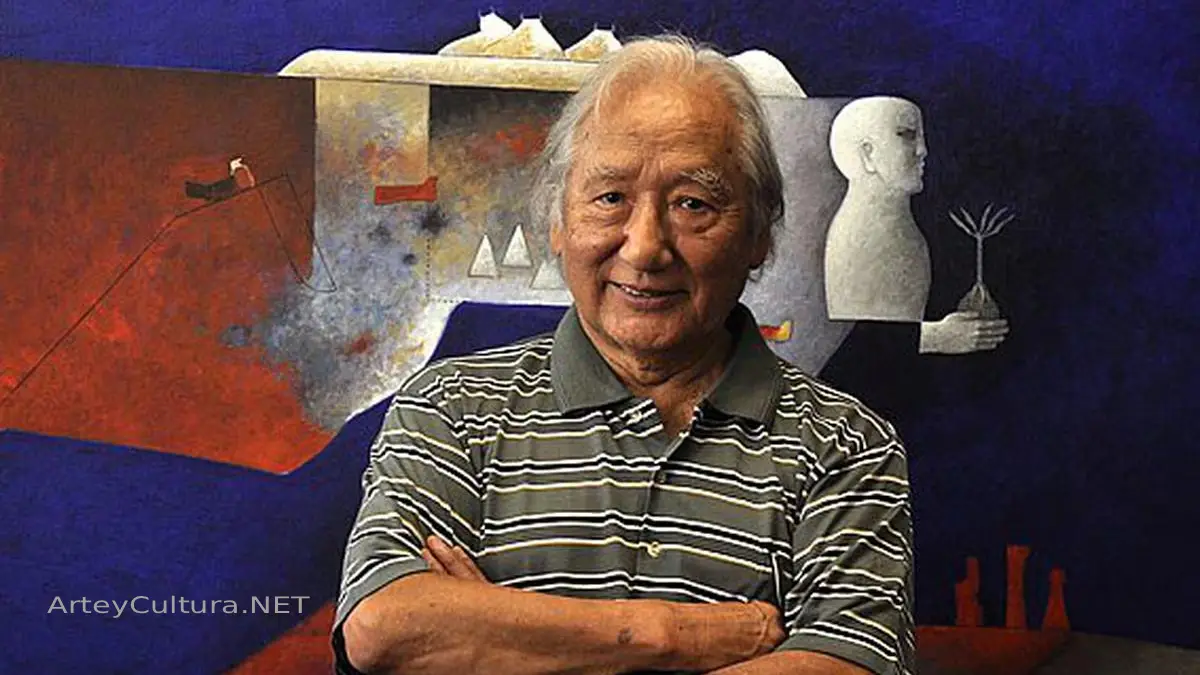
Venancio Shinki Huamán was born in Supe, Barranca province, on 1 April 1932 and died in Lima on 17 November 2016. A Peruvian painter and printmaker of Japanese and Andean descent, he created one of the country’s most personal twentieth-century bodies of work. Human figures, vegetation, celestial forms and imagined architecture meet in spaces where memory seems to become dream.
A childhood between inheritances
Shinki’s father was a Japanese immigrant and his mother was Peruvian with Andean roots. This double inheritance was not a biographical ornament. It supported a way of seeing from several positions at once: discipline and line, attachment to land, migration and cultural translation all entered his mature work.
The early death of both parents marked his childhood. Rather than illustrating loss literally, his paintings turn it into suspended figures, quiet atmospheres and interior landscapes. Their emotional meaning is often felt before it can be named.
Training at the National School of Fine Arts
He entered Peru’s National School of Fine Arts in Lima in 1954. There he received rigorous instruction in drawing, composition, painting and printmaking while encountering the modern debates reshaping Peruvian art. He graduated in 1962 with the Gold Medal and the special Sérvulo Gutiérrez Prize for painting.
Technical control made later freedom possible. Shinki understood anatomy and spatial organisation but gradually moved beyond naturalistic description. Bodies, plants, mountains and memories began to exchange forms inside deliberately ambiguous spaces.
A visual language of transformation
His painting is often associated with surrealism, but its imagination does not depend on importing a European formula. The Peruvian coast, Andean memory, Japanese migration, myth and urban life coexist without hierarchy. Elongated figures and organic masses appear to inhabit a universe with its own laws.
His palette ranges from dense earth colours to luminous blues, reds and violets. Colour does not decorate a pre-existing image; it creates psychological climate. Darkness can carry grief and depth, while a bright form becomes an impulse towards life.
The body as territory
In many paintings the human figure loses fixed boundaries. A torso extends into branches, stone or horizon. The body becomes a territory where desire, fragility, time and identity intersect. Women and couples are not conventional portraits but symbolic presences.
Eroticism is conveyed through proximity, curved forms and tension rather than explicit narrative. The openness prevents the picture from settling into a single explanation and invites each viewer to construct a relationship among its elements.
Awards and consolidation
During the 1960s Shinki received important recognition through the Hebraica Art Salon, the Peruvian–North American Cultural Institute and San Marcos University, as well as the Tecnoquímica and national Ignacio Merino prizes. These awards confirmed the emergence of a singular voice within a remarkable artistic generation.
He exhibited in Peru and abroad and developed printmaking alongside painting. Graphic work strengthened the precision of his line and ability to condense a scene. For Shinki, painting and print were complementary paths rather than separate careers.
Video: painting until the end
In this Spanish-language interview recorded by El Comercio, the veteran artist speaks about his continuing need to work. No equivalent English interview could be found. His voice, humour and physical relationship with the studio make the original an essential primary-source exception.
Video: cultural presence and the discipline of craft
This Spanish-language TV Perú conversation expands the portrait of the artist. It shows that dreamlike imagery does not oppose craft but grows from years of decisions and corrections. No substantial English alternative was available; the English commentary supplies context while preserving Shinki’s direct testimony.
Achievements and legacy
Shinki created a recognisable visual language joining Japanese, Andean and modern inheritances; graduated with his school’s highest distinctions; won major national prizes; and sustained more than five decades of painting and printmaking. He expanded the idea of Peruvian identity through a mestizo vision that was intimate without becoming closed or provincial.
His greatest achievement was transforming a life formed by several cultures into a coherent but never fixed artistic universe. Nature, body and memory continually change places. That openness keeps the paintings alive: every generation can enter them through a different route and discover that identity itself is made of encounters, losses and transformations.